


Team K9 Tips
A relax cue works best when you teach it before your dog is wound up, not in the middle of chaos. The useful goal is simple: give your dog one short cue, one calm place, and enough easy repetitions that settling starts to feel familiar.

How do you teach your dog a relax cue?
Start when your dog is already calm, guide them to one repeatable rest spot, say one short cue like “relax” or “settle,” and reward the small signs of softening: lying down, exhaling, lowering the head, or staying put. Then reuse the same pattern before predictable transition moments instead of waiting until your dog is already over-aroused.
A relax cue works when it predicts calm before your dog needs rescuing
Many dogs fail at “relax” because owners say it for the first time while the dog is already barking, pacing, spinning, or staring at the door. The cue gets stronger when it starts as a calm ritual, not a last-second plea.
Use the cue while your dog can still think, breathe, and make an easy choice.
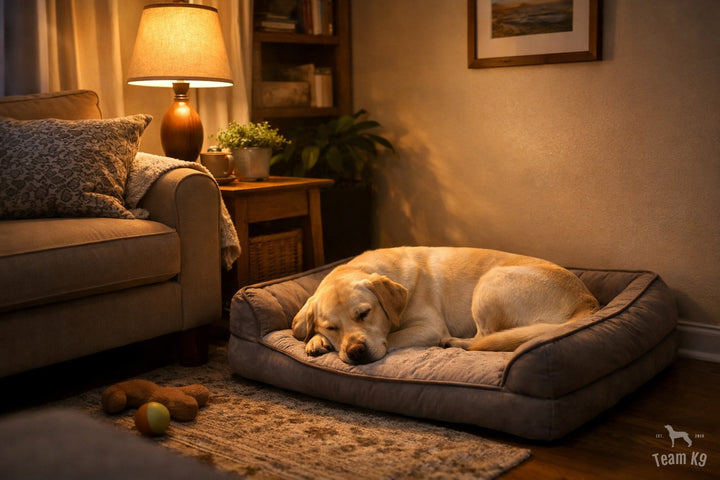
One bed, blanket, mat, or couch spot helps the cue mean something physical.
You are marking calm body language, not only obedience or stillness.
Guests, walks, car rides, and bedtime are easier when the dog already knows the landing pattern.
Every dog owner knows the moment. Your dog is pacing, whining, bouncing, barking, or staring at you with the “what happens next?” energy that turns a normal evening into a long one.
That is usually when people try a relax cue for the first time. They say “relax” because they need it to work right now.
The problem is not the word itself. The problem is timing. If your dog only hears the cue once they are already flooded with excitement, frustration, or stress, the cue has no calm history to lean on.
The useful reframe
Do not teach “relax” when your dog is failing. Teach it when your dog is capable, then borrow that pattern before the next hard moment starts.
1. Start when your dog is already calm
The fastest way to weaken a settle cue is to save it only for high drama. A new cue needs easy wins first.
That means picking a moment when your dog is already softer than usual: after a normal walk, during a quiet afternoon, while lying near you in the evening, or after they have naturally chosen to rest on their own.
When you see that calmer state, bring your dog to the rest spot if needed, say the cue once in a low voice, and reward the calm behavior that is already happening. This teaches the dog that “relax” predicts the state you want, rather than being a meaningless word attached to panic.
Teach the feeling before you test the word
If your dog only hears “relax” during barking, door drama, guest chaos, or leash frustration, they will connect the cue to conflict instead of recovery.
2. Pair the cue with one obvious calm spot
Many dogs settle faster when the cue points to something concrete: a bed, blanket, couch cover, crate mat, or floor spot they already know.
Without that physical anchor, “relax” can stay abstract. The dog hears the word, but does not know what action turns it into success. A visible rest zone makes the answer easier: go here, soften here, stay here for a moment.
The spot does not need to be fancy. It needs to be repeatable, safe, and easy to protect from traffic, rough play, and constant interruption.
| If this keeps happening | What it often means | Better next move |
|---|---|---|
| Your dog hears “relax” and keeps wandering | The cue may not point to a specific action or place yet. | Use one consistent bed, blanket, or mat so the cue has a destination. |
| Your dog lies down but pops back up quickly | The reps may be too long or the environment still feels busy. | Reward shorter wins and lower the room energy sooner. |
| The cue only works late at night | Your dog may only know it in one context. | Practice in easy daytime moments before guests, meals, or walks. |
| The cue never works when guests arrive | The dog may be too far over threshold for a brand-new cue. | Teach earlier and use the cue before the door opens, not after the explosion. |
3. Reward the small signs of settling, not just “down” as a position
A relax cue is not only about body placement. A dog can technically lie down and still be mentally buzzing.
Watch for the details that show the nervous system is actually changing: a deeper breath, a looser jaw, a hip dropping to one side, a head lowering, slower blinking, a sigh, or choosing to stay put without immediately popping back up.
Those are the moments worth marking. Over time, your dog learns that calm pays, not just that freezing in one pose earns a reward.
What to reward
Lower head. Softer body. Longer exhale. Choosing the spot again. Staying settled while you move a little. Those “boring” moments are the whole point of the cue.
4. Keep the first reps short enough to succeed
Many dogs fail because the owner asks for too much too quickly. A full ten-minute settle is not the starting line. One calm breath can count on day one.
Say the cue once, reward a few seconds of softness, then release before your dog has time to unravel. Small boring wins are what make the behavior easier to repeat tomorrow.
- Choose the calm spot. Bring your dog to the same bed, blanket, or mat.
- Say the cue once. Keep the word short and consistent: “relax,” “settle,” or “easy.”
- Reward quickly. Mark the first signs of softening instead of waiting for perfection.
- End before the dog gets restless. Short success teaches more than one long failed rep.
5. Reuse the cue before predictable transition moments
The real power of a relax cue shows up when you use it before situations that normally get noisy or frantic. That might be before the leash comes out, before dinner, before company walks in, before loading into the car, or before the household settles for the night.
This does two things. First, it gives your dog one familiar step inside an exciting pattern. Second, it stops you from always waiting until the dog is already spiraling.
Where a relax cue earns its keep
- Before guest arrivals. Cue the calm spot before the knock or door open.
- Before walks. Ask for one quiet settle before you clip the leash or harness.
- After walks. Use the cue to help the outside world end cleanly once you are back inside.
- Before car loading. Teach one short pause before the dog jumps in or starts pacing.
- At bedtime. Repeat the same cue and same landing spot as part of the night routine.
6. Know when the cue is not enough by itself
A relax cue is a helpful skill. It is not a cure-all.
If your dog is suddenly unable to settle, looks painful, panics when left alone, spirals into full reactivity, or shows major behavior changes with panting, vomiting, collapse, confusion, breathing issues, or distress, the answer is bigger than one word.
In those cases, use the cue only as part of a larger plan. The plan may include changing the environment, reducing trigger load, building more recovery into the day, working with a qualified trainer, or checking with your veterinarian.
Useful gear can make the calm pattern easier to repeat
These products support the routine by giving the cue a clear place to land or making transitions feel less chaotic. They do not teach the behavior by themselves, but they can make the reps easier to repeat honestly.
 Furniture Protector Dog Bed
Helpful when your dog needs one obvious padded place to land near you instead of roaming the whole room.
Furniture Protector Dog Bed
Helpful when your dog needs one obvious padded place to land near you instead of roaming the whole room.
 Water-Resistant Dog Throw Blanket
Useful when you want the same familiar rest layer to travel from couch to crate to floor to overnight stay.
Water-Resistant Dog Throw Blanket
Useful when you want the same familiar rest layer to travel from couch to crate to floor to overnight stay.
 Team K9 Tactical No-Pull Harness
Useful for calmer pre-walk structure when you want one quiet pause before the door opens, without pretending the harness itself teaches the settle cue.
Team K9 Tactical No-Pull Harness
Useful for calmer pre-walk structure when you want one quiet pause before the door opens, without pretending the harness itself teaches the settle cue.
When the cue keeps failing, troubleshoot the setup first
If “relax” is not working yet, do not assume your dog is stubborn. Check the setup.
Was the dog already too excited? Was the room too stimulating? Did the cue have a clear place to land? Were the reps too long? Did you only use the cue after chaos had already started?
Those questions usually matter more than finding a better word.
Relax cue FAQs
What word should I use for a dog relax cue?
Use a short consistent word like “relax,” “settle,” or “easy.” The exact word matters less than the calm repetition behind it.
Why does my dog ignore “relax” when guests arrive?
Many dogs ignore the cue because they were never taught it in easy low-stakes moments first. Teach the pattern while your dog is already calm, then use it before the excitement starts.
Should I say the cue over and over?
No. Say it once, guide your dog to success, and reward the small signs of settling. Repeating the cue while the dog keeps escalating usually weakens it.
Can I use the same cue for bedtime and guests?
Yes. That is one of the main advantages of the cue. It gives your dog one familiar calm pattern they can reuse across different transitions.
When should I get more help?
If your dog suddenly cannot settle, seems painful, panics, shows major behavior change, or the issue feels bigger than routine over-arousal, talk with your veterinarian or a qualified trainer.


 “He lunges at other dogs and I dread passing them”
 “My dog pulls on every walk”
 “I want control without a bulky vest”


Leave a dog-parent field note
Share what your dog does, what you already tried, or what you wish this guide covered. Notes are moderated before they appear.
Send the Team K9 crew the dog behavior, car setup, walk problem, or routine question you want covered next.
Email a field note