


Team K9 Tips
A lot of car-ride chaos starts before the car moves. The towel is buried, the back seat is half ready, the window decision happens while the dog is already climbing around, and the clip step turns into an afterthought. A short setup loop fixes more than most owners expect.
What should you check before you drive off with your dog?
Run the same four-point loop before you back out: seat, clip, air, and window. Make sure the landing spot is ready, the ride restraint step is handled before the wheels move, the air feels reasonable for the dog in the back, and the window plan is set before the ride turns into a moving debate.

The ride gets easier when you stop improvising these four steps
Most rough dog rides do not begin with a big mistake. They begin with four tiny misses: nowhere clear to land, no clean clip step, too much hot or stale air, and a window picture that gets set after the dog is already buzzing. Lock those down in the same order and the whole ride starts calmer.
The dog should have one obvious landing zone, not a pile of towels, buckles, and yesterday's mess.
The restraint step works best before the wheels move, not while the dog is already turning around.
The back seat often feels different from the front. A quick air check keeps the ride from starting stuffy or overblown.
Set the outside picture on purpose before the dog decides the whole ride is a full-body window patrol.
You can usually tell when the ride is starting sideways before you leave the driveway.
The leash is wrapped under the dog. The clip is still loose. A wet towel is bunched in one corner. Someone cracks the window wide because the dog looks excited, then spends the first five minutes renegotiating the whole back seat.
That is why the useful fix is not a giant checklist. It is one short loop that always happens in the same order. Your dog learns what the ride feels like at the start, and you stop trying to solve everything after the first turn.
The useful reframe
Do not ask whether the car is “mostly ready.” Ask whether the back-seat routine is clear enough that your dog can start the ride without confusion, tangles, or five competing inputs at once.
1. Start with the seat your dog is actually landing on
A lot of dogs enter the car with the same burst of energy every time. If the landing zone is cluttered, slick, damp, or half folded over, the ride starts with extra movement before the dog even settles. That makes everything after it feel harder.
Give the back seat one obvious answer before the dog hops in. Straighten the surface. Move the towel where you can reach it. Clear the clip path. If the dog always lands in the same place, treat that spot like the beginning of the routine instead of pretending the whole seat is equally usable.
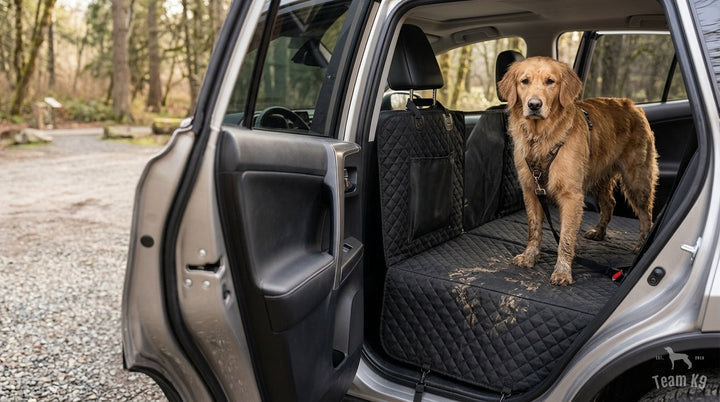
If your setup still relies on raw upholstery plus a drifting towel, a more defined base helps. The Team K9 Hard Bottom Car Seat Cover works well here because it gives the dog a clearer landing surface and gives you a faster cleanup point after muddy or hairy rides.
| Seat check | What you are looking for | Why it matters |
|---|---|---|
| Landing spot | Flat, clear, and easy for the dog to understand | A cleaner first landing usually means less scrambling and less mess migration. |
| Towel or wipe access | Reachable before the dog is already moving around | You are more likely to actually use it at the right moment. |
| Loose clutter | No tangled leash, half-open bag, or buckle buried under fabric | Small annoyances at the start become bigger movement problems once the dog is inside. |
| Wet or dirty leftovers | No old damp towel or crumb-heavy corner from the last ride | Yesterday's mess makes today's ride feel more chaotic faster. |
2. Handle the clip step before the car starts moving
This is the part that owners mean to do and then rush. The dog is already excited. Someone else is getting in. The phone is buzzing. So the clip step happens late or sloppily, and the ride begins with extra shifting around in the back seat.
Keep this step boring on purpose. Dog loads in. You clip in. Then you move on. If you use a restraint product for rides, treat it like a normal part of the start rather than the thing you remember halfway down the block.
The Team K9 Car Safety Belt makes more sense as a routine anchor than as a last-second correction. The win is the repeatable clip step, not a dramatic speech about the ride.
- Get the dog settled first. One clear landing spot makes the clip easier.
- Run the clip before you shift gears. Do not turn it into a moving-task problem.
- Keep the leash and clip path untangled. A calm start beats wrestling equipment in the driveway.

3. Check the air in the back seat, not just the front seat
What feels fine in the driver's seat can feel very different in the back. Sun, upholstery, panting, damp fur, and still air can make the ride feel bigger before the dog has even left the driveway.
You do not need a perfect science project here. You need one quick common-sense check. Is the back seat stuffy? Is your dog already warm from the walk or the load-in? Is the air moving in a way that helps the ride feel easier instead of more frantic?
This is also where a lot of people confuse movement for comfort. A blasting open window can make some dogs more keyed up, not less. Start with a reasonable air setup, then let the ride prove whether you need more.
The calmer move
Set the air for a steady ride, not for maximum excitement. A dog who starts the ride able to settle is easier to help than a dog who starts the ride amped and chasing every outside change.
4. Decide the window picture before your dog decides it for you
A lot of dogs love windows because the world gets bigger fast. More smell, more motion, more sound, more things to watch. That does not make windows bad. It just means the window setting is part of the routine, not an afterthought.
If your dog gets louder, whinier, or more frantic when the window is wide open, you do not need to run that experiment every single ride. Pick the version that helps the dog stay organized enough to actually enjoy the trip.
For some dogs that means a modest crack and a cleaner back-seat boundary. For others it means waiting to open more until the dog is already settled. The point is not control for its own sake. The point is preventing the first minute from becoming a full-body launch into every passing smell.
5. Build the ride around a repeatable setup, not one heroic rescue
The easiest dog rides usually look almost boring from the outside. The seat is ready. The clip step is obvious. The air and window are not being renegotiated every thirty seconds. The dog learns the shape of the routine and starts the ride from there.
That is where product support can help, but only if it supports the routine you are already trying to repeat. A protected base helps the seat check. A dedicated belt helps the clip step. A softer layer can help comfort once the base and restraint setup are already handled.
Use the setup to make the pre-drive loop easier to repeat
These products support the routine instead of replacing it. The better ride still comes from doing the same useful things before you pull out.
 Hard Bottom Car Seat Cover
Gives the dog a clearer landing zone and gives you a more wipeable base for the seat check.
Hard Bottom Car Seat Cover
Gives the dog a clearer landing zone and gives you a more wipeable base for the seat check.
 Car Safety Belt
Useful when you want the clip step to be a standard part of the ride start instead of a rushed afterthought.
Car Safety Belt
Useful when you want the clip step to be a standard part of the ride start instead of a rushed afterthought.
 Plush Backseat Dog Bed
Works best as the comfort layer after the protected base and clip routine are already making the ride easier.
Plush Backseat Dog Bed
Works best as the comfort layer after the protected base and clip routine are already making the ride easier.
The Team K9 30-second pre-drive car check
- Seat. Clear the landing spot and make the towel or wipe easy to reach.
- Clip. Run the ride-restraint step before the car moves.
- Air. Check how the back seat actually feels, not just the front.
- Window. Choose the outside picture on purpose before the dog starts chasing it.
6. When the first minute keeps going wrong, shorten the decisions
If every car ride starts with the same scramble, the answer is usually not more talking. It is fewer decisions at the moment they are happening. Put the towel in one place. Use one seat setup. Clip in the same order. Stop making the dog guess what kind of ride this is going to be.
That helps the human too. A short repeatable routine is easier to use when you are carrying groceries, dealing with weather, or loading up after a long walk. And if the first minute is cleaner, the rest of the ride usually has a better chance to stay that way.
Related Team K9 help for cleaner and calmer dog rides
If this pre-drive check overlaps with muddy rides, back-seat cleanup, or bigger dog-car setup questions, these pages help connect the full routine:
Pre-drive car ride FAQs
What is the most important thing to do before a dog car ride starts?
Make the ride start predictable. A clear landing spot and a handled clip step usually do more for the first minute than trying to correct chaos once the car is already moving.
Why does my dog get wilder the second we get in the car?
Many dogs are reacting to the whole load-in picture: excitement, movement, smells, gear shifting around, and a back seat that is not clearly set up yet. A calmer routine often reduces that jump in energy.
Should the window be fully open for my dog right away?
Not always. Some dogs get more organized with a smaller outside picture at the start of the ride. It helps to set the window on purpose instead of letting the first minute turn into a full-body window patrol.
How is this different from a muddy-ride cleanup routine?
This article is about what you check before the car moves. A muddy-ride reset happens after the ride, when you are cleaning the landing edge, door side, floor gap, and anything still wet.


 “My dog slides into the footwell”
 “Hair and mud end up all over my back seat”
 “My dog pulls on every walk”


Leave a dog-parent field note
Share what your dog does, what you already tried, or what you wish this guide covered. Notes are moderated before they appear.
Send the Team K9 crew the dog behavior, car setup, walk problem, or routine question you want covered next.
Email a field note