


Team K9 Tips
Boundaries work best when your dog understands what to do next. Before you say no, give your dog a clear job, a calmer setup, and a way to win.
Say yes to the replacement behavior first
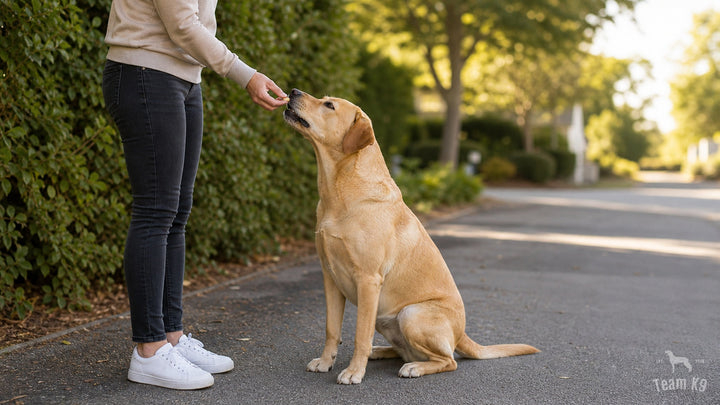
If your dog is jumping, grabbing, barking, rushing the door, or pushing into space, do not make the whole lesson about the word “no.” Pause, interrupt calmly, then show the behavior you want instead: sit, place, wait, walk with you, drop it, or move behind a boundary.
Clear boundaries are calmer than constant corrections.
A boundary is not a scare tactic. It is a repeatable pattern your dog can understand before the behavior becomes a full problem.
Stop feeding the chaotic behavior with motion, noise, or attention.
Ask for the behavior you want your dog to practice instead.
Mark the small moment when your dog chooses the better option.
Make the boundary predictable enough that your dog can learn the pattern.
It is easy to say “no” after your dog is already halfway into the wrong behavior.
They jump on a guest. They grab something off the floor. They rush through the door. They bark at the window. They crowd the kitchen. They pull toward another dog before you can think.
The problem is not that “no” is always useless. The problem is that “no” often arrives without a clear next step. Your dog hears that something is wrong, but they may not know what behavior would make the moment right.
Before saying no, decide what yes looks like
Every boundary needs a replacement behavior. If your dog jumps on guests, the replacement might be four paws on the floor. If your dog rushes the door, the replacement might be waiting behind the threshold. If your dog pulls toward a distraction, the replacement might be turning back toward you for one second.
The clearer the replacement, the less emotional the correction has to become.
The useful question
Do not only ask, “How do I stop this?” Ask, “What should my dog do instead right now?”
Use your setup to make the right choice easier
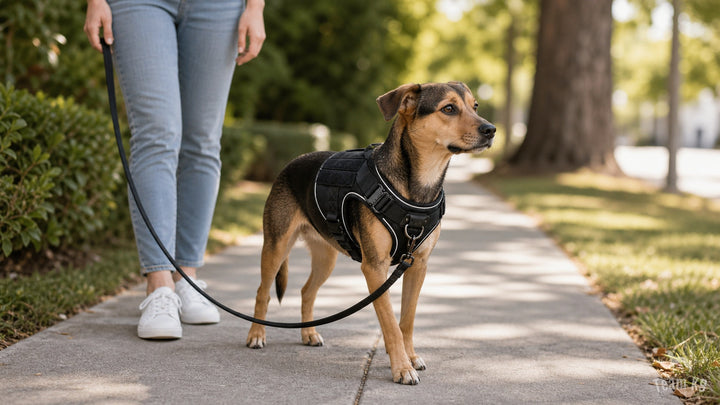
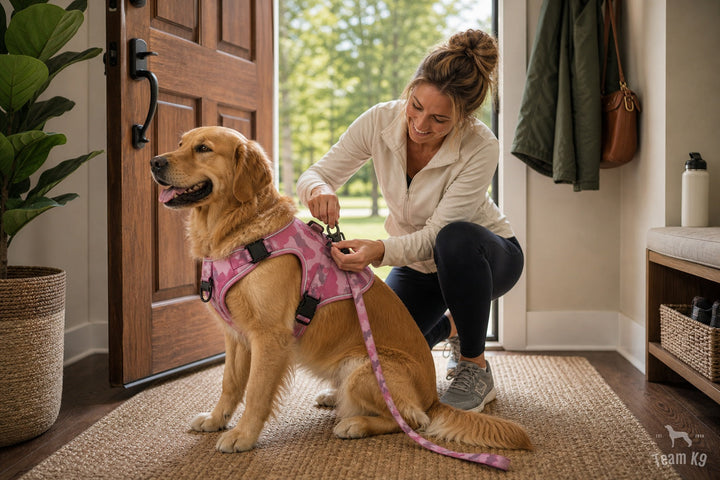
Dogs learn faster when the environment is not working against them. That might mean using a leash before guests enter, clipping into the Team K9® 4-metal-buckle harness before a busy walk, closing a baby gate before dinner, or keeping tempting items off the floor while you teach “leave it.”
Management is not failure. It is how you stop your dog from rehearsing the same unwanted behavior while you teach the better one.
Keep the correction small and the direction clear
A calm interrupt can be useful. A sharp “no” repeated ten times usually turns into background noise, or worse, makes the dog nervous without making the behavior clearer.
Try this sequence instead:
| Moment | What to do | Why it works |
|---|---|---|
| Your dog starts the behavior | Pause your movement and calmly interrupt. | You stop rewarding the pattern with more excitement. |
| Your dog gives you a small opening | Ask for the replacement behavior. | The dog gets information, not just disapproval. |
| Your dog shifts behavior | Reward immediately with praise, food, space, or access. | The new behavior starts paying better than the old one. |
| The moment repeats | Reset the environment and practice again. | Repetition turns the boundary into a routine. |
Do not wait until your dog is over the line
The best boundary happens early. If you wait until your dog is already barking, lunging, jumping, or sprinting through the door, you are teaching during the hardest part of the moment.
Watch for the first signs: weight shifting forward, eyes locking, body stiffening, ears changing, leash tension building, or your dog ignoring a cue they usually know.
That is your training window.
Use structure before pressure
For walks, start with the pre-walk reset. For car rides, build a clear backseat zone with a cover and restraint. For guests, set the boundary before the door opens.
Final thought
Your dog does not need a louder correction as much as they need a clearer pattern. Boundaries become easier when the dog knows where to go, what to do, and how to earn the next good thing.
That is the difference between constantly saying no and actually teaching the behavior you want to live with.


 “I want control without a bulky vest”
 “A collar chokes him when he pulls and I hate hearing it”
 “My dog is stronger than I am”


Leave a dog-parent field note
Share what your dog does, what you already tried, or what you wish this guide covered. Notes are moderated before they appear.
Send the Team K9 crew the dog behavior, car setup, walk problem, or routine question you want covered next.
Email a field note