


Behavior & calm
Guest greetings go better when your dog does not feel trapped, stared at, or rushed into contact. The useful Team K9 move is a calmer setup: let your dog choose the pace, make the space easier, and reward the first signs of steadiness before barking or shutdown takes over.
How do you help your dog meet new people calmly?
Start with less pressure, not more enthusiasm. Ask the person to ignore your dog at first, give your dog room to watch from a safe distance, reward calm check-ins or easy approaches, and end the greeting before your dog gets flooded. The goal is not to force friendliness. It is to build trust and predictability.
Many “bad greetings” begin with a well-meaning rush: the door opens, the guest leans in, hands reach out, voices get bright, and the dog is suddenly expected to handle the whole social moment on command.
If your dog barks, jumps, backs away, freezes, or hides, that does not automatically mean they are stubborn or antisocial. It usually means the greeting got too big, too fast, or too close.
Calm greetings are built from choice, distance, and timing
Dogs tend to feel safer when they can observe first, move away if needed, and approach on their own terms. When the picture stays small enough to think through, you get more real confidence and less reactive noise.
You do not need your dog to love every visitor. You need a repeatable way for your dog to stay steadier when people come into the picture.
Read the greeting problem correctly before trying to fix it
Not every rough greeting has the same emotional root. Some dogs are overexcited and launch forward. Some bark because they are unsure. Some shut down because the space feels inescapable. Your first move should match the reason the dog is struggling.
| If the greeting looks like this | It often means | Your first move |
|---|---|---|
| Jumping, whining, pulling forward | Overexcitement or frantic social energy | Slow the entrance, pause access, and reward four paws down before contact. |
| Barking from the doorway or behind you | Alerting, uncertainty, or social pressure | Create more distance and let the guest stay neutral instead of coaxing. |
| Backing away, freezing, or hiding | Fear, avoidance, or overwhelm | Stop the reach-in, let your dog retreat, and keep the interaction optional. |
| Seems fine, then suddenly snaps or explodes | Quiet stress signals were missed early | Rewind the setup and start looking for earlier body-language warnings. |
Use this four-step guest greeting setup
The low-pressure intro
Keep the interaction smaller than your dog's stress threshold. That is what makes learning possible.
No reaching, no eye contact, no big hello the second the door opens.
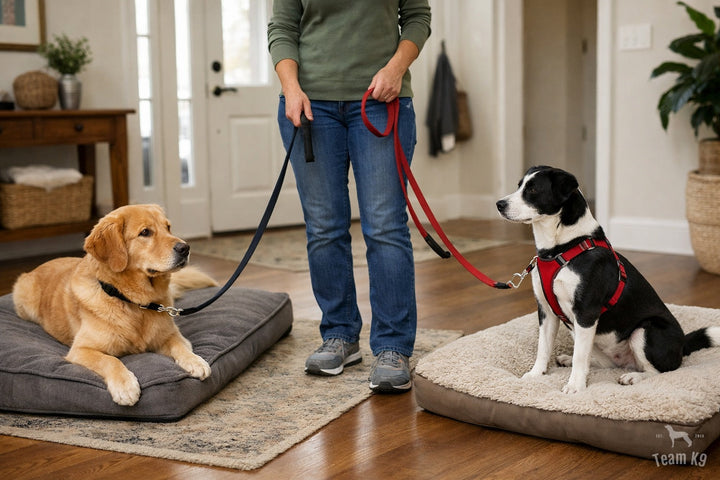
Let your dog watch from a mat, bed, hallway, or wider doorway instead of trapping them in tight space.
Mark the pause, the glance back, or the easy sniff before arousal spikes.
Walk away, reset, and try later rather than forcing a longer greeting after the dog is done.
Let your dog be the one who closes the gap
If your dog has to move toward the new person to investigate, that is usually more useful than having the new person move into your dog’s space. Dogs tend to feel more in control when they can choose whether to approach, pause, arc away, or come back.
That means the guest should stay soft and boring at first. Stand or sit slightly sideways. Keep hands still. Let your dog collect information without being lured, cornered, or called in too early.
If your dog walks over, sniffs, and then leaves, let that count as success. A calm check-out is often a better sign than a pressured “say hi” that turns into barking ten seconds later.
Build the room for success before the person comes inside
Many greeting problems are environment problems dressed up as obedience problems. Narrow entryways, a busy foyer, kids moving around, and multiple people crowding the dog can make the situation harder than it needs to be.
Before guests arrive, clear a landing zone. That could mean opening a wider path, moving the dog to a quieter room first, or setting up one obvious station where your dog can decompress while the house settles.
If you need help spotting the first pressure signals before the greeting gets loud, pair this article with How To Stress Check Your Dog Before Behavior Escalates and Understanding Your Dog's Body Language.
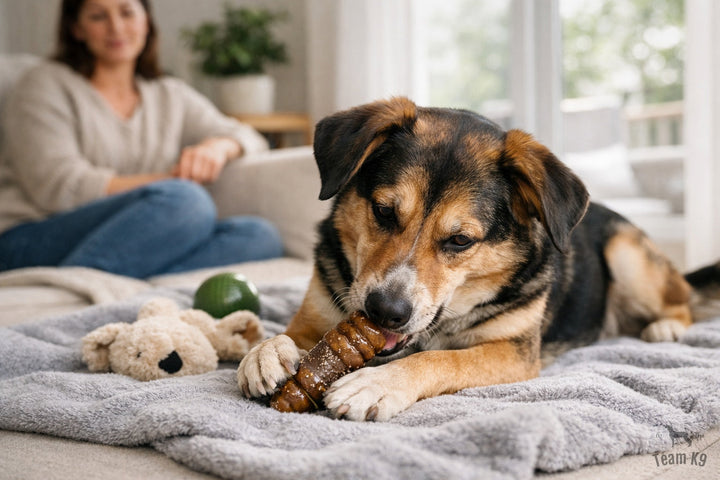
Make the calm station easy to recognize
Gear does not solve the greeting by itself. It only helps when it supports a clearer, lower-pressure routine.

Coach the guest as much as the dog
A lot of greetings fall apart because the human side changes every time. One guest crouches and grabs. Another leans over the head. Another keeps calling the dog across the room. Your dog has to decode a new social script on every rep.
Make the script simple and consistent:
- Ignore the dog for the first minute.
- Keep hands to yourself unless the dog clearly asks for contact.
- Toss treats to the side or behind the dog instead of into their face.
- Stop after one or two calm approaches instead of stretching the greeting too long.
This is especially important if your dog already tends to bark when the house gets noisy. If the doorbell or doorway itself is part of the pattern, the companion read is How To Stop Excessive Barking Without Yelling At Your Dog.
Use body language to decide whether to continue
Do not judge the greeting only by whether the tail is moving. Look at the whole dog. A loose body, softer eyes, normal breathing, and the ability to eat or disengage are better signs than a fast wag paired with stiffness, hard staring, or repeated lip licking.
If your dog keeps turning away, yawning, freezing, ducking contact, backing behind you, or taking a treat and immediately retreating, that is useful information. Lower the difficulty. Do not keep trying to “finish the greeting” just because the guest is nice.
When your dog has trouble settling after the person arrives, the next piece to build is recovery, not more social pressure. That is where How To Teach Your Dog A Relax Cue That Actually Helps Them Settle becomes useful.
Outdoor meet-and-greets can be easier than doorway greetings
Some dogs do much better if the first hello happens outside, where there is more room to move and less pressure around a front door. A few parallel steps, a wider arc, or a brief pause in a driveway can be easier than a stranger appearing suddenly inside the house.
That does not mean every dog needs an outdoor intro every time. It means if your dog struggles with the doorway picture, change the picture instead of repeating the same failure at the same threshold.
When to stop troubleshooting it as a simple manners issue
Get more help if your dog is escalating to snapping, biting, panic-level barking, repeated barrier crashing, or intense avoidance that is not improving when you lower pressure. That is the point where a qualified positive-reinforcement trainer or veterinary behavior professional should help you build a more specific plan.
FAQ
Should guests pet my dog right away if my dog approaches?
Not automatically. Let the first approach stay short and low-pressure. A sniff and retreat can be enough. If your dog returns with softer body language, brief gentle contact may be appropriate.
What if my dog barks the second the door opens?
Start farther upstream. Work on the doorway picture itself, reduce visual pressure, and make the first job after the sound or entry very clear. Do not wait until the dog is already fully activated to create the plan.
Is it bad if my dog does not want to greet every visitor?
No. The goal is not forced sociability. The useful goal is calmer, safer behavior and a dog who trusts that they will not be pushed past what they can handle.
Can I use treats if my dog is nervous around people?
Yes, if the treats reduce pressure instead of increasing it. Tossing them to the side or behind the dog is usually more helpful than asking the dog to come take food from a stranger’s hand.


 “He lunges at other dogs and I dread passing them”
 “My dog pulls on every walk”
 “I want control without a bulky vest”



Leave a dog-parent field note
Share what your dog does, what you already tried, or what you wish this guide covered. Notes are moderated before they appear.
Send the Team K9 crew the dog behavior, car setup, walk problem, or routine question you want covered next.
Email a field note