


Team K9 Tips
Baseboards, leashes, paws, and gentle little nibbles do not all mean the same thing. Decode the chewing pattern first so you can answer boredom, overload, discomfort, or affection with the right next move instead of one blanket correction.

Why does my dog chew different things in different situations?
Because chewing is often a symptom pattern, not one single behavior problem. Furniture chewing can point to under-stimulation or stress, leash mouthing often points to over-arousal on walks, paw chewing can point to discomfort or stress carryover, and gentle cobbing is often social grooming or affection. The useful move is to match the routine fix to the pattern you are actually seeing.
Not all chewing is asking for the same help
Owners get stuck when every chew gets treated like defiance. What matters more is where it shows up, what happened right before it, and whether your dog looks underworked, overloaded, uncomfortable, or socially connected.
Often points to boredom, frustration, or alone-time stress.
Often shows up when walk arousal gets too high too fast.
May point to discomfort, stress, or routine instability.
Usually read more like cobbing, comfort, or social grooming.
Chewing becomes much less mysterious when you stop asking, "How do I make this stop?" and start asking, "What problem is my dog trying to solve right now?"
That does not mean every chew is harmless. It means the same outward behavior can come from very different internal states. Treating all of them as stubbornness usually hides the real pattern and keeps the routine stuck.
The useful reframe
Chewing is often a clue about arousal, comfort, energy, or social need. The target matters. The timing matters. The moment before it starts matters even more.
1. Furniture chewing usually points to underworked brains or stress that needs an outlet
If your dog keeps working on baseboards, table legs, shoes, couch corners, or whatever was left near the doorway, the pattern is usually bigger than "they know they are being bad." Most dogs do not choose drywall because it is especially rewarding. They choose repetitive chewing because it gives them something intense and absorbing to do.
Sometimes that is boredom. Sometimes it is alone-time stress. Sometimes it is a dog who had physical exercise but no real problem-solving, sniffing, or calm-down routine afterward.
- Look at what happens before the chewing window opens. Is it right after you leave, right before dinner, or after a rushed high-energy day?
- Add a harder brain job before the danger window. Sniffing, short training, scatter feeding, or simple search games often help more than another chaotic game of fetch.
- Give one legal settling outlet. A safe supervised chew, stuffed toy, or calmer landing zone works better than waiting for the wrong object to become the project.
If your dog is restless indoors and keeps inventing their own jobs, read How To Tire Out Your Dog Without Adding A Longer Walk and The Five-Minute Sniffari You Can Set Up Today for lower-drama ways to drain the brain first.
Many "destruction" problems are really unmet transition problems
A dog who goes from nothing to too much and back to nothing again often makes their own outlet. Chewing is one of the easiest self-assigned jobs they can find.
Make the calm option easier to find
These Team K9 items do not solve the root cause by themselves, but they can make a lower-arousal indoor reset easier to repeat once you have the routine right.
 Furniture Protector Couch Cover
Useful when your dog needs one obvious calm landing surface instead of drifting from couch edge to floor to doorway with too much leftover energy.
Furniture Protector Couch Cover
Useful when your dog needs one obvious calm landing surface instead of drifting from couch edge to floor to doorway with too much leftover energy.
 Water-Resistant Dog Throw Blanket
Helps mark a repeatable settle spot on the couch, bench, crate area, or floor corner when you are trying to make the calm routine clearer.
Water-Resistant Dog Throw Blanket
Helps mark a repeatable settle spot on the couch, bench, crate area, or floor corner when you are trying to make the calm routine clearer.
2. Leash biting or sleeve grabbing usually means the walk got too hot too fast
When a dog whips around and grabs the leash, your sleeve, or the dangling end of the setup, it often looks rude or chaotic. Most of the time it is a dog whose arousal spiked past their thinking range. The sights, motion, frustration, anticipation, or trigger load got too high, and the mouth became the fastest outlet.
That does not automatically mean aggression. It often means the walk needed an earlier downshift.
- Reduce pressure sooner. Turn earlier, create more distance, or pause before the dog tips into full-body frantic behavior.
- Shorten the first high-arousal stretch. Many dogs struggle most in the first minute out the door or right after seeing a trigger.
- Give the dog a simpler job. Sniff, hand target, check-in, or carry an approved object if that actually helps your dog stay organized.
If your dog starts walks too hot, pair this article with The Doorway Pause Before You Open The Door and The 90-Second Pre-Walk Reset. The fix often begins before the leash gets bitten, not after.

Cleaner handling can make resets less frantic
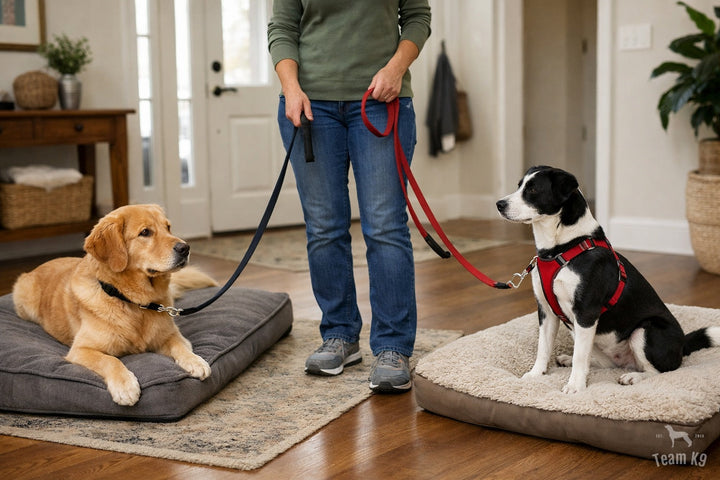
Gear is not the behavior plan, but secure handling can make early-turn, calmer-reset reps easier when the mouth starts searching for an outlet.
 Metal Buckle Harness
 Tactical Leash
3. Paw chewing deserves a stress-and-comfort check, not just a behavior label
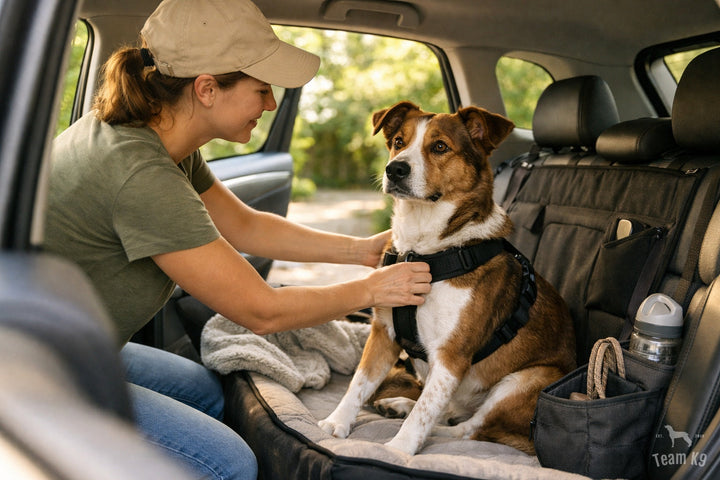
Paw chewing can come from skin irritation, but it can also flare when a dog feels physically unsettled, slides around in the car, carries stress home from a busy outing, or has no reliable calm routine after overload. That is why the timing matters so much.
- If it happens after rides, look at stability and decompression.
- If it happens after busy days, look at recovery, not only exercise.
- If it happens constantly or the skin is raw, stop guessing and talk to your vet.
The home version of this pattern often sounds like, "My dog finally lies down, then starts chewing paws the second things get quiet." That can be a clue that the body is down but the nervous system is not fully settled yet.
For the recovery side of that problem, read How To Help Your Dog Feel Better In The Car and What To Do When Your Dog Comes Home Wired After Boarding Or Daycare.
4. Cobbing is often the one chewing pattern that is not a problem at all
Cobbing is the tiny front-tooth nibbling many dogs do on a blanket, another dog, or a trusted person. It usually looks gentle and rhythmic, not frantic or destructive. In many dogs it reads more like social grooming, comfort, or affectionate ritual than stress behavior.
That does not mean every mouth-on-human moment should be encouraged. It means you should notice the difference between a hard, escalating chew pattern and a soft little nibble that appears when your dog is relaxed and socially connected.
If the moment feels familiar, Why Dogs Bring You Their Favorite Toy When You're Sad sits in the same lane of everyday dog logic and affectionate rituals.
When to stop troubleshooting at home
If chewing is causing injury, swallowing risk, broken skin, severe panic when left alone, or sudden behavior change without an obvious routine explanation, bring in your veterinarian or a qualified positive-reinforcement behavior professional. This article is for pattern-reading, not for replacing medical or individualized behavior care.
FAQ
Why does my dog chew furniture when I leave?
That pattern often points to boredom, frustration, or separation-related stress. Look at the transition before you leave, the amount of mental work your dog got first, and whether they have one safe legal outlet when the house gets quiet.
Why does my dog bite the leash during walks?
It often happens when arousal climbs too fast. The dog may be frustrated, overstimulated, or searching for an outlet the second the walk gets too intense. Earlier resets usually work better than stronger corrections.
Is paw chewing always allergies?
No. Allergies are one possible cause, but stress, discomfort, routine instability, or post-outing carryover can matter too. If the skin is irritated or the pattern is constant, get veterinary guidance instead of guessing.
What is cobbing in dogs?
Cobbing is a soft front-tooth nibbling pattern that often looks like social grooming or affection. It usually feels very different from destructive, frantic, or stress-heavy chewing.
Should I punish chewing?
Blanket punishment often misses the cause and can add more stress. Management, earlier pattern-reading, and better outlets usually help more than reacting after the chew already happened.


 “He lunges at other dogs and I dread passing them”
 “My dog pulls on every walk”
 “I want control without a bulky vest”



Leave a dog-parent field note
Share what your dog does, what you already tried, or what you wish this guide covered. Notes are moderated before they appear.
Send the Team K9 crew the dog behavior, car setup, walk problem, or routine question you want covered next.
Email a field note