


Why it works
Most wild walks are already wild before the first step.
The leash comes out, the dog spins, the human rushes, the door opens, and the first few steps teach the dog that pulling is the pattern. By the time you are on the sidewalk, the environment is loud and the leash is already tight.
The reset below is not a punishment and it is not a long training session. It is a short setup routine that changes the opening scene of the walk. You are slowing down the moment where your dog usually rehearses launch energy, then replacing it with a few small jobs they can understand.
Use it before neighborhood walks, before loading into the car for a trail, or any time your dog gets overexcited around the door. The goal is simple: start with enough slack and enough attention that the first outside choice is easier to reward.

The doorway sequence
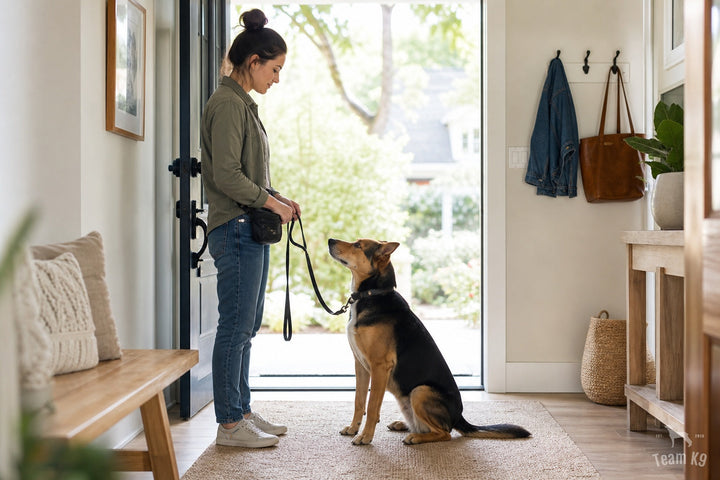
Run this once before the leash gets tight.
Do the sequence in the same order each time. Keep your voice low, your hands slow, and your criteria small enough that your dog can win before you leave the house.
Pause the pattern
Stand still for 10 to 20 seconds before clipping in. You are not waiting for perfect obedience. You are waiting for one softer beat: four paws down, less spinning, or a glance back at you.
Check the setup
Make sure the harness sits flat, the leash is not wrapped around a leg, and your hand is on the right handle before the door opens. Fixing gear outside usually costs you the first minute.
Use one release cue
Pick a simple word like "walk" or "let's go" and use it only when you are ready to move. If your dog surges before the cue, close the loop and reset the doorway moment.
Scan before stepping out
Look for the first trigger: dog across the street, delivery cart, skateboard, car door, tight hallway, or neighbor. Your first choice outside should be planned, not surprised.
Choose your next step
Use the reset today. Then choose the path that earns the next click.
Start with the doorway sequence. If the first minute still gets loud, click into the behavior guide that matches the problem or move straight into the walk setup that makes handling easier.
From the Team K9 inbox
Useful tips should be easy to try.
That is the standard for this page: one routine you can run before the next walk, article paths for the problem you are seeing, and a clear shop path when the setup needs help.
"I have gotten so much benefit from the dog training tips that come in my email. I have tried several of the tips and they work well with easy to understand instructions and uncomplicated applications. Thanks so much. And PS I did just order a harness today." Customer note shared with Team K9
When the first minute goes sideways
Match the reset to the thing your dog is actually doing.
Find the moment that looks most like your dog, then use the smallest reset first. If you need more help, each path points to the next useful guide or setup.
Dog jumps while you clip the leash.
Pick up the leash, wait for four paws down, then clip. If jumping returns, set the leash down and restart smaller.
Dog mouths or grabs the leash.
Freeze your hands, ask for one known cue, then move only when the leash is quiet again.
Dog blasts through the opening.
Open the door two inches, close it if your dog surges, and release only after a small pause.
Dog scans for other dogs immediately.
Scan before stepping out, choose a wider path, and reward attention before the other dog becomes the whole walk.
Dog freezes or refuses to leave.
Make the first rep smaller. Step out, praise calmly, then step back in before asking for a full walk.
Walk setup
The gear is not the training. It is the part that keeps the training usable.
A no-pull harness cannot teach the whole walk by itself, but a better setup gives you cleaner handling options during the exact moment your dog wants to launch.
Before the door opens, decide which leash attachment and handle you are using. Front attachment helps with redirection. Back attachment gives more normal walking space when the dog is already calmer. The close handle matters near doorways, corners, traffic, and passing dogs.
Think of this setup section as the bridge between the routine and the product path. The reset gives your dog a calmer first job. The right harness, leash, and patches make that job easier to repeat.
- 01 Choose the attachment point on purpose. Front for more redirection, back for calmer stretches, and switch when the environment changes.
- 02 Clip before excitement peaks. If your dog is already bouncing, pause the setup instead of rushing the door.
- 03 Keep the close handle available. Shorten up near tight corners, street crossings, and passing moments before the leash becomes a contest.
- 04 Give space when the dog settles. Use structure at the hard moments, then return to normal leash length when the walk is workable.
Build the walk setup
Build the setup around the routine.
A calmer start comes from the routine first. The right harness, leash, and patches make that routine easier to repeat when the doorway, sidewalk, or passing moments get busy.
 Start here
Tactical No-Pull Dog Harness
Front and back leash attachment points, adjustable straps, metal buckles, top handle, reflective details, and hook-and-loop panels.
Shop the harness
Start here
Tactical No-Pull Dog Harness
Front and back leash attachment points, adjustable straps, metal buckles, top handle, reflective details, and hook-and-loop panels.
Shop the harness
 Add control
Tactical Bungee Leash
Use the close handle for doorways, street crossings, and tight passing moments, then give your dog more walking space when the leash is calm.
Shop the leash
Add control
Tactical Bungee Leash
Use the close handle for doorways, street crossings, and tight passing moments, then give your dog more walking space when the leash is calm.
Shop the leash
 Signal clearly
Patch Bundle
Use simple visual communication when your dog is training, nervous, friendly, working, or needs extra space around people and dogs.
Shop patches
Signal clearly
Patch Bundle
Use simple visual communication when your dog is training, nervous, friendly, working, or needs extra space around people and dogs.
Shop patches
FAQ
Pre-walk reset questions
Will this stop my dog from pulling on the whole walk?
Not by itself. The reset changes the first pattern so you have a better starting point. You still need to reward slack leash moments, create distance from triggers, and practice in environments your dog can handle.
Should I use the front or back leash attachment?
Use the front attachment when your dog needs more redirection at the start of the walk. Use the back attachment for calmer stretches or dogs that already understand the routine. Many owners switch based on the environment.
What if my dog lunges as soon as the door opens?
Make the door part smaller. Open it two inches, close it if your dog surges, then ask for one easy behavior before trying again. If a trigger is already outside, wait or choose a different exit path.
Should I let my dog sniff during the first minute?
Yes, once the leash is usable and the first release cue is clear. Sniffing can help many dogs settle, but it should not start as a full-speed drag toward the first smell.
How long should I try the reset?
Try it for seven days in a row. Keep the first reps easy and consistent. If your dog is fearful, reactive, or unsafe to handle, work with a qualified trainer who can see the full context.
Next walk
Run the reset once before you step out today.
Start with the doorway sequence. If the first minute still gets away from you, read the guide that matches the problem or shop the setup that makes the routine easier to repeat.


 “I want control without a bulky vest”
 “A collar chokes him when he pulls and I hate hearing it”
 “My dog is stronger than I am”



Leave a dog-parent field note
Share what your dog does, what you already tried, or what you wish this guide covered. Notes are moderated before they appear.
Send the Team K9 crew the dog behavior, car setup, walk problem, or routine question you want covered next.
Email a field note