


Team K9 Tips
Some dogs do better with five calm minutes of searching than with five louder minutes of trying to burn energy off. A simple sniffari gives your dog a quiet job, lets you watch how they work through a small puzzle, and can turn an ordinary yard or living-room stretch into a steadier part of the day.
How do you set up a five-minute sniffari for your dog?
Pick a quiet space, hide three small treats in easy-to-find spots, stand back instead of coaching every second, and stop while your dog still seems engaged. The useful version is simple enough that your dog can keep working instead of getting frustrated early.

The whole game gets easier when these four pieces stay simple
The point of a sniffari is not to prove anything about your dog. It is to give them a short search they can understand, let you notice when they are still working versus when they need help, and end before the game turns into a bigger project than it needs to be.
Use a low-traffic patch of floor or grass where the search is not competing with foot traffic, doorbells, or the next big event.
Start with one obvious treat, then step up gently instead of jumping straight into a hard scent puzzle.
Notice when your dog is still searching the area versus when they have clearly drifted off the game and need a small clue.
Wrap while your dog still looks interested so the next round feels like something worth doing again.
A lot of owners hear “mental stimulation” and picture a giant project.
But a good sniffari is usually much smaller than that. It can be one porch chair, one open box, one patch of shaded grass, and three tiny hides that ask your dog to slow down and work through the space with their nose instead of their whole body.
That smaller shape is part of what makes the game useful. It is not another way to wind a dog up. It is a five-minute job that often helps the afternoon feel more settled than it did before you started.
The useful reframe
Do not ask whether the game looks impressive. Ask whether your dog can stay in it long enough to keep searching, find a few easy wins, and finish the round still feeling like the game made sense.
1. Pick a quiet space your dog can actually think in
A sniffari works best when the search picture is small enough to hold attention. Kitchens, living rooms, patios, and shaded corners of the yard all work well when there is not a lot of extra motion pulling your dog away every few seconds.
That is why the quiet-space part matters more than fancy setup. If the back door keeps opening, kids are sprinting by, or the space is full of other food smells and clutter, the game gets harder before your dog even reaches the first hide.
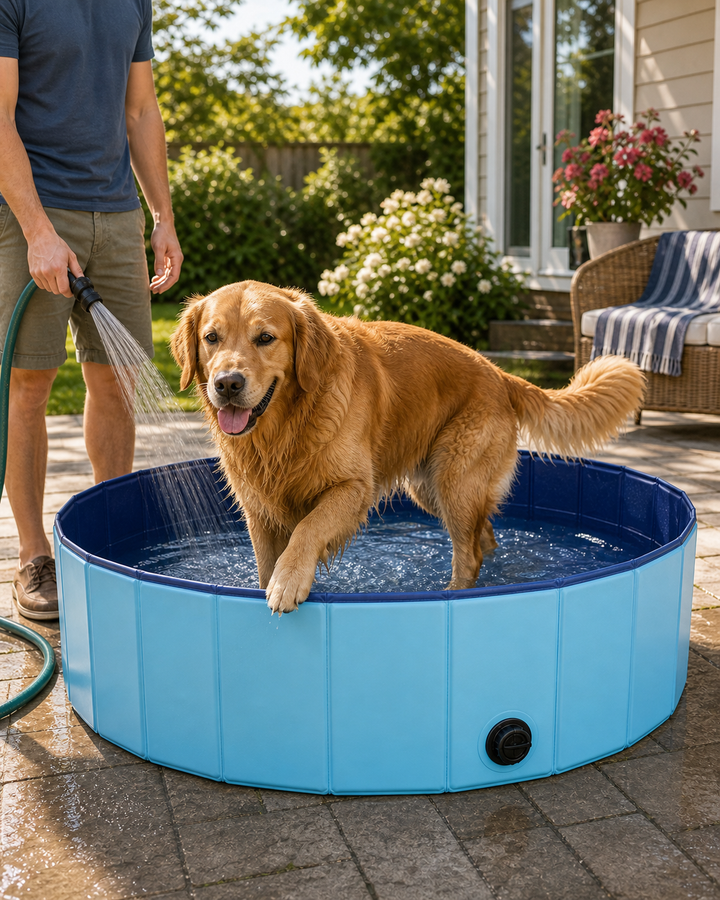
Keep the first round almost boring. A little room, a few small treats your dog already likes, and a place where you can step back and watch is enough. If the day is warm and the yard is the natural next stop afterward, it can help to already have the Team K9 Foldable Dog Pool set up nearby so the transition after the game feels easy instead of rushed.
2. Build three hides that step up gently instead of all at once
The easiest version is one hide your dog almost cannot miss, one that sits a little more tucked away, and one that asks for a small circle-back before the treat gets found. That shape gives the game a rhythm without turning it into a hard puzzle.
| Hide | What it looks like | Why it helps |
|---|---|---|
| Hide 1 | Partly visible beside a chair leg or just under a cushion edge | Shows your dog the game fast and keeps the first win easy. |
| Hide 2 | Tucked behind something low or just inside an open box | Adds one step without making the dog guess the whole room. |
| Hide 3 | A spot your dog already walked past once | Encourages a small loop back instead of a straight-line search every time. |
Keep the treats small and low-mess. A game usually moves along better when your dog can find, eat, and move on in a few seconds instead of turning one hide into a long chewing stop.

3. Watch for whether your dog is still working or already asking for help
A lot of the value in a sniffari comes from noticing the difference between a dog who is still engaged in the search and a dog who has clearly moved on. If your dog keeps circling back to the same spot, slows down near one patch of grass, or keeps their nose low and active, that usually means the search is still alive there.
If your dog instead walks off toward the door, lies down, or starts checking you instead of the floor, that is a good time to help rather than pretending the game has to stay independent. You can tap near the hide, use a familiar word, or take one step closer so the next clue becomes easier to read.
The calmer move
Helping is not cheating. The point of a sniffari is a useful few minutes together, not a perfect search that turns into confusion because you waited too long to make the next rep easier.
4. Stop while the game still feels like a good idea
Five minutes is a reasonable target, not a strict rule. Some dogs will still be moving with purpose a little longer. Others lose steam by the third hide, especially on warm days or in a more distracting space. The useful cue is not the timer. It is the moment your dog starts looking less direct, less interested, or more done.
Ending after a good find is usually better than stretching the game until focus fades out. That gives you a cleaner finish and makes it easier to repeat the same routine another day.
If the next part of the day is a walk, the simplest bridge is usually to keep the picture quiet and move into your regular setup instead of suddenly ramping the energy back up. The Team K9 Tactical No-Pull Dog Harness and Tactical Bungee Dog Leash fit that kind of calmer transition because they support a steady hand-held routine after the search instead of turning the next step into another scramble.
Useful Team K9 gear for the yard side and walk side of the routine
These products support what naturally happens around the game: a warm-yard cooldown after the search or a calmer hand-off into the next walk.
 Foldable Dog Pool
A simple warm-day landing spot when backyard sniffing naturally turns into hose, shade, and cooldown time.
Foldable Dog Pool
A simple warm-day landing spot when backyard sniffing naturally turns into hose, shade, and cooldown time.
 Tactical Harness
Useful when the next stop after the game is an everyday walk and you want the hand-off to feel steadier.
Tactical Harness
Useful when the next stop after the game is an everyday walk and you want the hand-off to feel steadier.
 Better Walk Blueprint
Use the free walk plan if the calm search helps, but the first minute outside still needs a cleaner system.
Better Walk Blueprint
Use the free walk plan if the calm search helps, but the first minute outside still needs a cleaner system.
The Team K9 five-minute sniffari loop
- Pick the space. Use a quiet floor or yard patch with fewer competing distractions.
- Hide three treats. Start easy, then step up gently.
- Stand back. Let your dog work instead of narrating every second.
- Help if needed. Give a small clue when your dog has clearly moved off the search.
- Stop on a good find. End while the game still feels worth repeating.
5. Use this when your dog needs a quieter job, not a bigger one
A sniffari is not the answer to every behavior problem, and it is not a replacement for walks, training, or rest. It is simply a short nose-led job that can fit well on a slower afternoon, a warm weekend, or a day when your dog seems to need something calmer than another loud burst of activity.
That is also why it makes sense as a repeatable Team K9 tip. It gives owners something small enough to try today, while still connecting naturally to the walk system, backyard routines, and cooler-car transitions that happen around it.
Related Team K9 help for calm routines, walks, and outdoor transitions
If this five-minute game helps but you want the next step for walks, sniff stops, or calmer routines, these reads connect well:
Five-minute sniffari FAQs
Does a sniffari need special equipment?
No. A quiet space and a few small treats are enough. The useful version is simple enough that your dog can understand the game quickly.
What if my dog finds the first hide immediately?
That is fine. The first hide is supposed to feel easy. The game builds from there with one or two slightly harder spots.
How do I know when to help?
If your dog keeps checking the same area, they are probably still working. If they wander off, lie down, or stop caring about the floor entirely, that is a good moment to give a small clue.
Is this better than taking another walk?
It is different, not better in every case. A sniffari is useful when you want a short calm search or when the day calls for a quieter job instead of immediately adding more motion.


 “He lunges at other dogs and I dread passing them”
 “My dog pulls on every walk”
 “I want control without a bulky vest”



Leave a dog-parent field note
Share what your dog does, what you already tried, or what you wish this guide covered. Notes are moderated before they appear.
Send the Team K9 crew the dog behavior, car setup, walk problem, or routine question you want covered next.
Email a field note